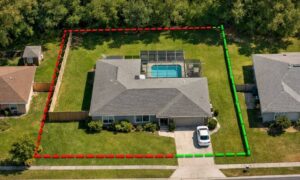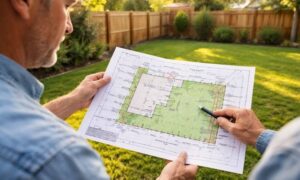
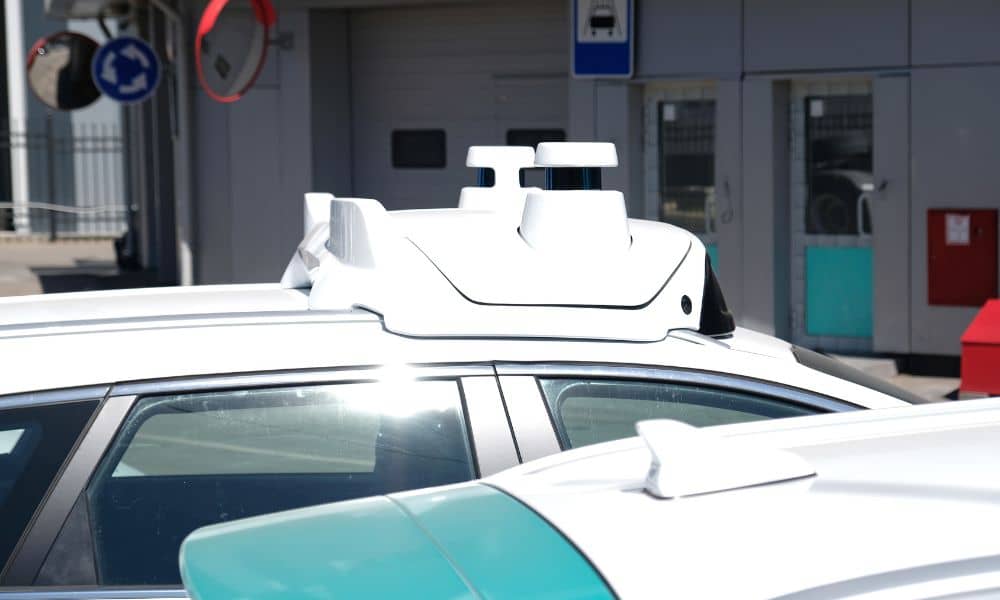
Robotaxis are in the news again. Every few days, a new clip goes viral showing a self-driving car making the wrong turn, braking late, or bumping into something it didn’t “see.” A lot of people are asking why this keeps happening. Others want to know why companies didn’t use better sensors in the first place. And that question connects directly to land development here in Orlando, because lidar mapping is the same technology surveyors use to make sure a project begins with accurate data. When the sensors fail, the entire plan becomes risky.
Today, we are seeing this exact issue play out in public. Self-driving cars are struggling because they don’t understand their environment clearly. Developers face the same danger when they start a project with incomplete site information. The stakes aren’t just financial—they affect safety, drainage, utilities, and construction schedules. That’s why many engineers, surveyors, and builders are pushing for better mapping tools before site work even begins.
The Robotaxi Problem
In most videos, the robotaxis are reacting like they are confused. They stop suddenly for no reason. They drift too close to curbs. They get trapped in tight turns. While the clips can be funny online, the reality behind them is serious.
These vehicles rely on sensors instead of human eyes. Some companies use cameras only, which means the vehicle sees the world like a video screen. However, cameras struggle at night, in shadows, during storms, or when objects blend into the background. When sensors fail, mistakes happen fast.
This is almost the exact challenge land surveyors solved years ago.
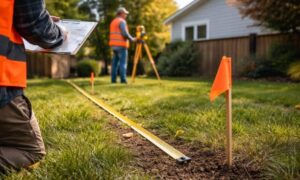
Surveyors also need to “see” terrain accurately. A camera is not enough when measuring slopes, trees, ditches, sidewalks, driveways, curbs, and utilities. Therefore, surveyors use multiple tools together: GNSS, total stations, and lidar mapping. While robotaxis are still figuring this out, surveyors already rely on mixed data sources to get reliable measurements.
What LiDAR Mapping Actually Does

LiDAR is short for “light detection and ranging.” Instead of taking a picture, a LiDAR sensor sends out thousands of laser pulses per second. Each pulse bounces off the ground or another surface and returns to the sensor. Because we know the speed of light, the system calculates distance instantly.
In simple terms: LiDAR builds a real 3-D picture of everything around you.
That includes:
- pavements
- trees and branches
- buildings
- drainage paths
- embankments
- slopes
- ditches
- fences
- roadway edges
This is why LiDAR is used in both autonomous vehicles and land surveying. Yet unlike robotaxis, surveyors combine LiDAR with traditional tools to improve accuracy even more. As a result, they avoid the sensor blind spots that cause mistakes.
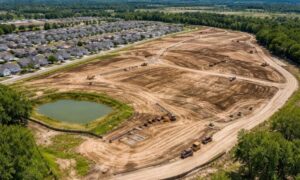
Using LiDAR, surveyors can build exact surface models, find changes in elevation, and capture fine site details. That helps engineers design without guessing. Since land development projects move fast, LiDAR also gives teams a strong reference from the very beginning.
Why Needs Better Site Data
Orlando looks flat, but it is not simple.
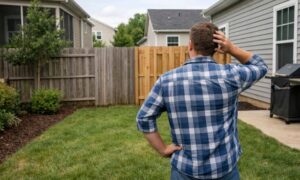
Developers who work here know this. A property that seems straightforward can still include unseen problems. And because central Florida terrain changes fast, old surveys become unreliable faster than you expect.
These issues are common across Orlando:
Tree canopy: blocks camera views, hides grade changes Mixed utilities: buried lines near sidewalks Stormwater challenges: invisible slope variations Old easements: unclear boundaries in older neighborhoods Driveway crossings: water movement across pavement
Without clear mapping, design assumptions collapse. And when assumptions collapse, delays begin. The most expensive phrase in construction is: “We have to go back and fix this.”
LiDAR mapping reduces that risk. It gives engineers the true ground condition before any dirt moves. It shows where water collects. It reveals grade shifts that can affect drainage. It exposes hidden slope breaks that cameras miss.
One strong dataset protects everyone:
- owners
- engineers
- builders
- lenders
- inspectors
When the design team starts with accurate site information, the project moves with confidence instead of fear.
Lessons From Robotaxis That Apply to Site Planning
The robotaxi videos teach us something valuable.
First lesson: Cheap sensors equal costly mistakes. When a robotaxi uses only cameras, visibility fails. Similarly, when a developer skips detailed mapping, the project will meet surprises later.
Second lesson: Good data beats assumptions. The cars rely on real-time sensor data to understand their path. Site planning is the same. Assumptions break projects. Data prevents that.
Third lesson: Accuracy builds trust. In autonomous vehicles, trust is everything. For land development, it works the same way. If your mapping is solid, your entire construction team trusts the plan. When mapping is weak, everyone becomes nervous.
Fourth lesson: Redundancy protects projects. If one method fails, another must back it up. Surveyors have known this for years.
That’s why a strong land development survey uses:
- LiDAR mapping
- GNSS positioning
- total station checks
- manual verification
- ground truth confirmation
Robotaxis are still learning this lesson. Surveyors already mastered it.
What Happens When a Project Skips LiDAR
Developers sometimes try to save a little money by choosing the simplest survey package. But the cost comes later.
When LiDAR is missing, risks rise:
- grading changes get missed
- slopes appear incorrect
- utility paths are unclear
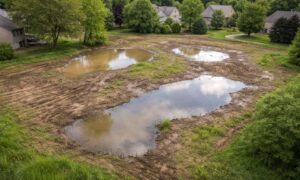
- water flows differently than expected
- drainage fails
Suddenly the design must change. Then permits delay. Then construction slows down. Finally—costs rise. And unlike a self-driving car, a failed drainage system affects hundreds of people, not just one vehicle.
What Happens When a Project Uses LiDAR Mapping
The opposite also happens.
When teams start with complete LiDAR mapping, the outcome changes dramatically.
Design becomes faster. Engineering feels easier. Fewer surprises pop up. Contractors move confidently. Schedules tighten. Budgets hold steady.
Better data simplifies everything.
LiDAR gives builders early vision into the project. Instead of reacting, they plan. Instead of guessing, they decide. Instead of patching, they prevent.
Final Thought
Robotaxis keep crashing for a clear reason: they don’t see the world accurately enough. Their data isn’t complete. Their understanding is blurry.
If self-driving cars cannot operate safely without precise sensing, how can we expect a land development project to succeed without precise mapping?
Clear visibility is everything. So before design begins, before grading starts, before utilities move—ask one question:
Did we get LiDAR mapping done first? Because the future belongs to projects that see clearly, from day one.